Archives for category: sciencenews

Here’s a graph of 5-minute averaged gross X-ray flux for the past couple days from the GOES satellite. Basically, it’s a graph of energy in certain wavelength bands being emitted by the Sun :

It’s logarithmic, but don’t worry about that if you don’t understand it. The letters on the right are the weight classes for coronal mass ejections, or solar flares. As and Bs are your intercontinental phone line static and X is your transformers-exploding geomagnetic superstorm.

The other day, there was a C3 class flare from Earth-facing sunspot 1092. It’s a pretty moderate size as these things go, but probably just enough to touch off the Northern Lights. But here’s the cool part. The coronal mass ejection triggered a larger solar event, ripping a huge magnetic filament off with it. I think that’s the filament across the top in the image below from SOHO.

The filament is around half a million miles long— twice the distance between Earth and the Moon— and the whole damn thing took off with the flare and heaved straight for Earth.

Fingers crossed for dark clear skies— there oughta be one hell of an aurora at the least.

I saw on CNN.com breaking news about a 7.3 in the Moro Gulf, off the Philippines. CNN said it was “616 kilometers (575 miles) deep,” so I headed to usgs.gov to see which number was wrong. Arrived to pre-CNN news that the 616 was right— for the second of two 7.4 events within half an hour of eachother. The first earthquake was 576 kilometers deep; both are way deeper than the shallow Pacific Northwest variety I’m more used to.

Pretty funny screwup for CNN.com but not for poor Mindanao. Beam positive juju— they got hit horrifically by a tsunami from the same seismogenic zone in 1976.

An ESA mission made a flyby of the largest asteroid yet visited by human spacecraft.

There’s some pretty cool pictures on the ESA website— but I wanted to show off something that caught even my sleepy eye. Check out these subparallel grooves from another set of Rosetta images:

It took some looking, but I eventually figured out where I’d seen those grooves before.

That’s Phobos— one of the moons of Mars. (It’s mostly visible light, if you’re wondering; some near-infrared as well). You can see those same sorts of grooves, which used to be blamed on Stickney Crater, which the big dimple near the bottom right— those are landslides on its crater rim! A 2006 paper mapped them to show the grooves fall into 12 general age groups and hypothesized they could represent scoring from regular deliveries of ejecta from impacts next door. But Lutetia is a wandering asteroid… what would score it with crater chains on a regular basis? The main belt is far too capricious a place to expect such precision. It’s not like the Empire Strikes Back in there.

There’s a partial lunar eclipse overnight— or rather in the very early morning.

It’ll be to the southwest and low to the horizon— sets up here right around 5 o’clock. Sam and I realized that’s only an hour before we’ve been getting up these days, so we’re going to make a go of it.

It’s not a typo.

Today, in Shamelessly Stolen, I read an article on Bad Astronomer about breathless rumors of an imminent supernova at everyone’s favorite supergiant— Betelgeuse, Betelgeuse, Betelgeuse! It’s been known to be shrinking for a while and, when it goes, it’ll briefly be two and a half times brighter than the moon.

Some guy, soapboxing on a Life After The Oil Crash forum, said his son knew somebody who knew somebody who said the latest observations from Mauna Kea showed a rapid shift to an oblate, non-spheroid shape, purple monkey dishwasher. Bad Astronomer kind of shits all over the idea it’s going to blow (rightfully so with the attribution available, anyway), but here’s where the Shamelessly Stolen bit comes in:

One of the top comments on reddit for the story pointed the way towards the website for the SuperNova Early Warning System— specifically, its mailing list, where you can sign up for automatic emails announcing a rapid increase in neutrino flux. When a star undergoes Type II core collapse, its infalling matter becomes dense enough for electrons and protons to overcome their mutual hatred and merge, giving birth to neutrons and neutrinos. Neutrinos are the ninjas of the subatomic particle world— small, electrically neutral and moving near the speed of light, they whiz around and through ordinary matter mostly unmolested. (Count to one. 50000000000000 neutrinos from Sol just moved through your body.) Fleeing the dying star, they’ll be our first sign that a nearby star is about to buy the farm. As long as it’s not close enough to fry us with gamma rays, it should be one of the singular events of the next millennium.

A team of researchers sequenced the gene to produce wooly mammoth hemoglobin.

Then they inserted the gene into bacteria which grew it— and it has anti-freeze properties. Let’s hope dinosaur urine cures cancer and that can be the science story of 2010 instead of ongoing ecological devastation.

(By the way— regarding the Gulf disaster— I really hope it stops increasing exponentially soon. 5k a day— 20k— 200k gallons a day according to this article! I think that’s about 3/10ths of an Olympic size swimming pool. But I also noticed the estimate of total discharge in that article was 1.6 million— almost an order of magnitude less than the estimate I read in another article today.

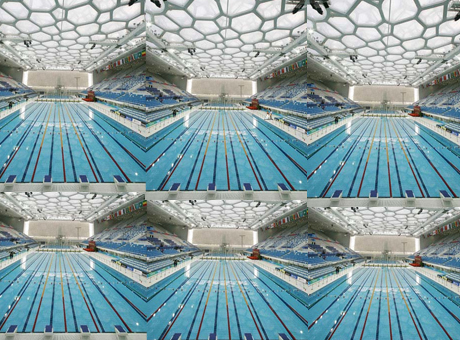
That’s about 4.2 million gallons then— six Olympic size swimming pools. See if you can find Sam and I getting married for scale.)

Jeez, Louise— only a theoretical physicist would make gravity a function of an expanding information limit sphere on the edge of the universe spitting entropy into the system. It’s in the third to last paragraph, if you still want to read the article based on that excerpt. It makes my head hurt in the same way this Scrabble hand did:

Hope for an open A? Noun highway? All due credit to anyone who can figure out a salvageable play there.